The CTO of a Sydney-based professional services firm called us three months into their AI pilot. Her voice carried that specific mix of frustration and resignation.
“We launched with so much energy,” she said. “Now I can’t get anyone to return my emails about it.”
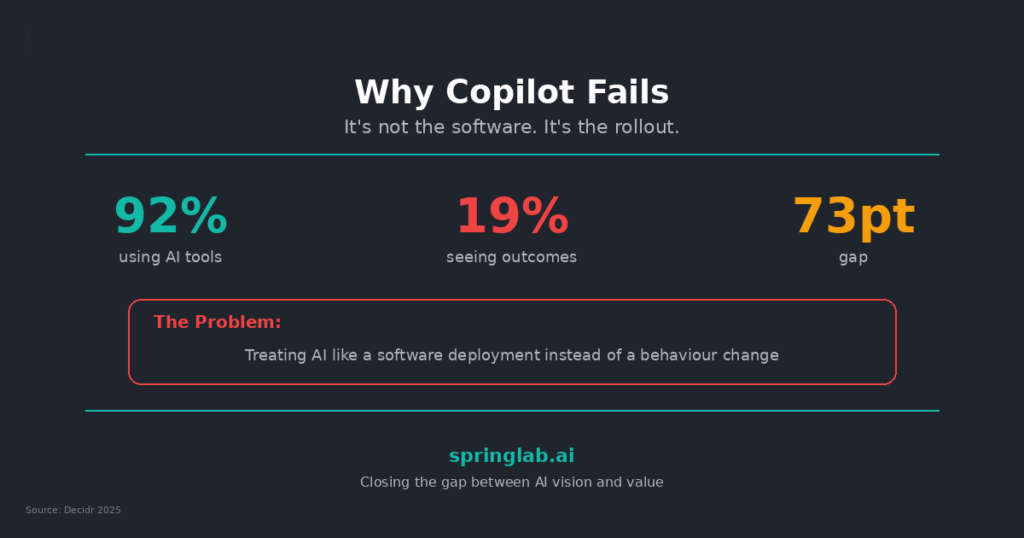
She wasn’t describing a technology failure. The platform worked. The integrations were solid. The problem was everything around it.
According to Stanford’s 2025 AI Index Report, only 6% of enterprises successfully move AI pilots into production. The other 94% stall, quietly get shelved, or become expensive experiments that leadership doesn’t want to talk about.
Here are the five warning signs we see most often — and what to do about each.
Sign 1: Nobody Can Explain Why It Matters
Ask three people on the pilot team what success looks like. If you get three different answers — or worse, blank stares — you have a clarity problem.
The fix: Define one measurable outcome in plain language. Not “improve efficiency” but “reduce invoice processing time from 4 hours to 1 hour per week.” If you can’t measure it, you can’t prove it worked.
Sign 2: The Sponsor Has Gone Quiet
Every successful AI project needs an executive sponsor who stays visible. When that person stops attending updates, stops asking questions, or delegates to someone junior — the project is losing air cover.
The fix: Re-engage the sponsor with a 10-minute brief. Show them one quick win, one risk, and one decision you need from them. Make it easy to stay involved.
Sign 3: Users Aren’t Using It
You’ve built it. You’ve launched it. And the adoption dashboard shows a flatline.
Gartner’s 2025 research shows that 78% of AI tool underutilisation traces back to poor change management — not poor technology.
The fix: Go back to users and ask: what’s stopping you? Is it training? Is it trust? Is it relevance? Often the tool solves a problem nobody actually has. Better to learn that now than after renewal.
Sign 4: The Data Is a Mess
You can’t automate a broken process. If the AI is producing inconsistent outputs, hallucinating, or requiring constant manual correction, the issue is usually upstream — in your data quality, structure, or access.
The fix: Pause the pilot. Run a data readiness check. You may need to clean, tag, or restructure inputs before automation will work reliably. It’s not glamorous, but it’s non-negotiable.
Sign 5: No One Owns What Happens Next
The pilot finishes. The vendor sends a summary. And then… nothing. No scale plan. No budget ask. No roadmap.
The fix: Before the pilot ends, document: What worked? What didn’t? What’s needed to scale? Who owns the next phase? If those answers don’t exist, the pilot dies by neglect.
The Bigger Picture
A failed pilot isn’t always a waste. Sometimes it’s the fastest way to learn what your organisation isn’t ready for. But most pilots don’t fail because the idea was wrong — they fail because the conditions for success were never set up.
As MIT Sloan’s 2025 AI Leadership Study noted, “The bottleneck in AI adoption is rarely the algorithm. It’s the organisation.”
If you’re seeing any of these signs, now is the time to act — not after the budget review.
→ Learn more about our 5-Day AI Sprint
Sources: Stanford AI Index Report 2025; Gartner Digital Workplace Survey 2025; MIT Sloan AI Leadership Study 2025.