A CEO in Adelaide asked me a question I hear almost every week: “Should we build our own AI, buy something off the shelf, or work with a partner?”
Behind the question was a deeper anxiety — the fear of making the wrong call. Building sounds expensive. Buying feels generic. Partnering means trusting someone else with critical systems.
There’s no universal right answer. But there is a decision framework that makes the choice clearer.
First: What Are We Actually Talking About?
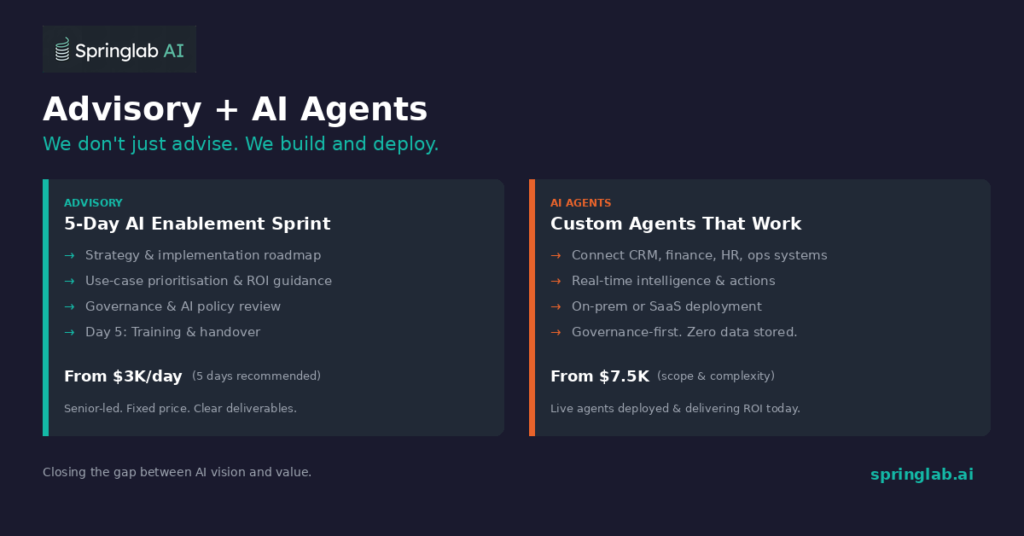
An AI agent is software that connects to your business systems — CRM, finance, HR, operations — and performs tasks autonomously. It might answer customer queries, process invoices, flag risks, or generate reports.
According to Gartner’s 2025 AI Agents Market Guide, by 2027, 50% of enterprises will use AI agents for at least one core business process. For SMEs, the question isn’t if — it’s how.
Option 1: Build
When it makes sense:
• You have a unique workflow that no off-the-shelf product addresses
• You have in-house engineering capacity (or budget to hire it)
• You want full control over data, logic, and IP
Watch out for:
• Underestimating maintenance costs — AI models need ongoing tuning
• Time to value — custom builds take 6–12 months minimum
• Key-person risk — what happens when your one AI engineer leaves?
Build is best for organisations with differentiated processes and long-term technical investment appetite.
Option 2: Buy
When it makes sense:
• Your use case is common (customer support, document processing, sales enablement)
• You need to move fast — weeks, not months
• You want predictable pricing and vendor support
Watch out for:
• Vendor lock-in — can you export your data if you switch?
• Limited customisation — the tool works for 80% of your process, but not the 20% that matters
• Hidden costs — integration, training, and API fees add up
Buy is best when the problem is well-defined and the tool is proven in your industry.
Option 3: Partner
When it makes sense:
• You need custom capability but don’t have in-house expertise
• You want a solution tailored to your workflows and data
• You value speed and want to deploy in weeks, not quarters
Watch out for:
• Dependency on the partner — what happens after handover?
• Governance gaps — who owns the model, the data, the outputs?
• Scope creep — clear deliverables matter
Partner is best when you need tailored AI but lack internal capability to build it yourself.
The Decision Filter
Ask these five questions:
1. Is our use case unique or common? Unique → Build or Partner. Common → Buy.
2. Do we have internal AI/ML capability? Yes → Build. No → Buy or Partner.
3. How fast do we need results? 3+ months → Build. Weeks → Buy or Partner.
4. How critical is customisation? High → Build or Partner. Low → Buy.
5. What’s our risk tolerance? High → Build. Low → Buy or Partner with clear SLAs.
What We’re Seeing in Australian SMEs
Most mid-market organisations (50–500 employees) don’t have dedicated AI teams. Building from scratch rarely makes sense. The choice is usually between buying a platform and adapting to its constraints — or partnering to get something tailored without the full build burden.
We’ve built AI agents like Ion (connecting CRM, payments, and enrolment systems) and Orbit (automating assessment grading in education) for organisations that needed more than off-the-shelf but couldn’t justify a full engineering hire.
The right answer depends on your context. But the worst answer is no decision at all — because while you’re deliberating, your competitors are deploying.
→ Learn more about our AI SaaS Platform
Sources: Gartner AI Agents Market Guide 2025.